Running a small business is a constant balancing act. On one side, you’re focused on delivering your product or service well. On the other, you’re trying to grow. That means answering calls, responding to inquiries, following up on quotes, scheduling appointments, managing marketing, watching your numbers, and making decisions about what to prioritize next.
The reality is that most small business owners are not limited by opportunity. They are limited by capacity.
There are only so many conversations you can handle in a day. Only so many follow-ups you can remember. Only so much mental energy you can devote to tracking performance while also doing the actual work of running the business.
This is where AI agents become relevant. Not as a futuristic concept, but as a practical operational layer that can support and in some cases run major parts of a small business.
If you’ve heard the term “AI agent” and wondered what it actually means, this article will walk through it in detail: what AI agents are, how they differ from basic automation tools, what parts of your business they can manage, and how they impact revenue, efficiency, and growth.
.webp)
What Is an AI Agent?
An AI agent is a system designed to take actions in order to achieve a goal.
Traditional software waits for input. You log in, click buttons, send messages, or trigger workflows. Even basic automation follows strict rules: “If this happens, then do that.”
An AI agent goes further. It can observe incoming information, interpret context, make decisions, and take multiple steps without you manually guiding each one.
For example, imagine the goal is to convert new leads into booked appointments. A simple automation might send a single email when someone fills out a form. An AI agent, on the other hand, can respond instantly via text, ask follow-up questions, qualify the prospect, offer available time slots, confirm the booking, send reminders before the appointment, and check in afterward. If the lead doesn’t respond, it can continue following up at reasonable intervals.
It is not just reacting. It is operating toward an outcome.
This shift from “tools you use” to “systems that operate on your behalf” is what makes AI agents fundamentally different from earlier generations of software.
Why Small Businesses Struggle With Execution
To understand the value of AI agents, it helps to look at where small businesses commonly lose momentum.
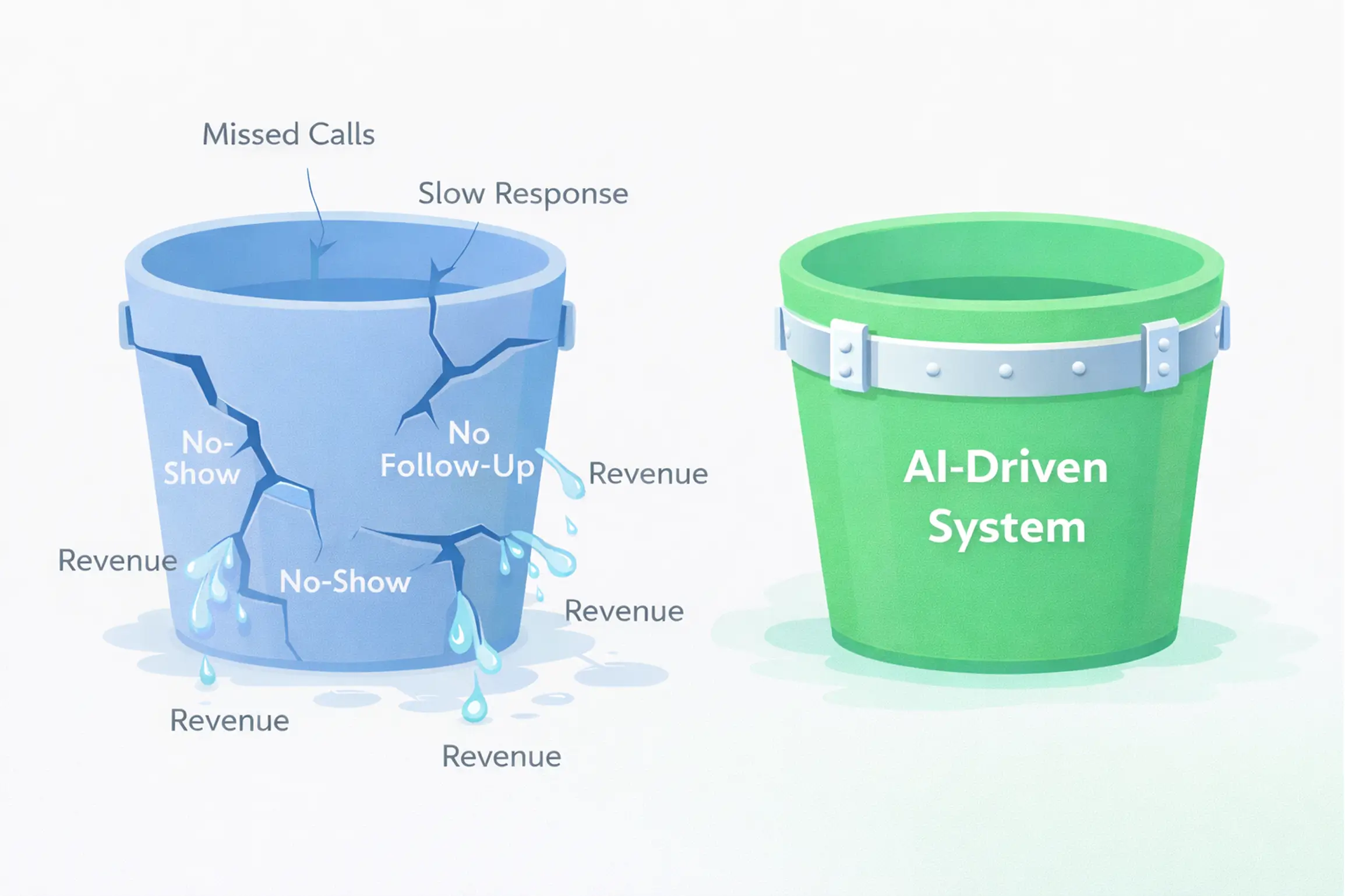
A missed call during a busy afternoon. A web form submitted late at night that doesn’t get a response until the next day. A quote that was sent but never followed up on. An appointment reminder that slipped through the cracks. A past customer who quietly churned because no one checked in.
None of these issues feel dramatic on their own. But they compound. Over time, they create inconsistent revenue and unpredictable growth.
Most small businesses do not have a strategy problem. They know what to do. They know they should follow up faster, nurture leads longer, request reviews consistently, and monitor performance weekly.
The issue is bandwidth.
When business gets busy, reactive tasks take priority over proactive ones. Follow-ups happen when you remember. Marketing runs when you have time. Performance reviews happen after something already feels off.
AI agents address this execution gap. They introduce consistency into areas where human capacity naturally fluctuates.
Where AI Agents Can Operate Inside a Small Business
AI agents can run significant portions of daily operations. While they don’t replace high-level strategy or human judgment, they are highly effective in areas that rely on structured communication and repeatable processes.
Communication and First Contact
Inbound communication is one of the most critical parts of any service-based business. Whether it’s calls, texts, emails, or web forms, first contact often determines whether a prospect becomes a customer.
An AI agent can answer calls around the clock, respond instantly to missed calls, handle common questions, and book appointments directly into your calendar. If someone reaches out after hours, they don’t have to wait until the next morning for a response.
This matters because speed influences conversion. The business that responds first often wins.
Instead of relying on voicemail or delayed replies, AI agents keep the conversation active immediately. That alone can significantly increase booked appointments without increasing advertising spend.
Lead Qualification and Follow-Up
Not every inquiry is ready to buy. Some prospects are researching. Some are comparing options. Others are price-shopping.
AI agents can ask structured qualifying questions to understand urgency, budget, and fit. They can score leads and prioritize the most promising opportunities. If a prospect is not ready immediately, the agent can continue nurturing the relationship over time.
Follow-up is where many businesses lose revenue. A quote is sent, but no one checks back in. A prospect says they need time to think, and the conversation fades.
AI agents remove the reliance on memory. They can follow up consistently, space messages appropriately, and continue engaging prospects until a clear outcome is reached. This systematic follow-up often uncovers revenue that would otherwise have been lost.
Scheduling and No-Show Management
Scheduling friction slows down sales cycles. Back-and-forth messaging about availability reduces momentum and increases the likelihood that a prospect disengages.
AI agents can offer real-time availability, confirm bookings, handle rescheduling, and send automated reminders. They can even follow up if someone fails to confirm.
Reducing no-shows protects revenue that has already been earned. Increasing scheduling speed improves conversion rates. Both have a direct financial impact.
Ongoing Marketing and Retention
Many small businesses treat marketing as an activity that happens in bursts. When things slow down, marketing ramps up. When things get busy, it stops.
AI agents can stabilize this cycle by running consistent background marketing efforts. They can request reviews after completed services, re-engage customers who haven’t returned in a set period, and send targeted promotions based on customer history.
Retention is often more profitable than acquisition. AI agents make retention systematic rather than accidental.
Performance Monitoring and Operational Awareness
One of the less obvious advantages of AI agents is their ability to monitor performance continuously.
Instead of logging into multiple dashboards, you can have an agent track response times, booking rates, show-up rates, and revenue trends. If something drops below normal levels, you can be alerted early.
This shifts management from reactive to proactive. Instead of discovering a problem at the end of a bad month, you identify it while there is still time to correct it.
Do AI Agents Replace Employees?
This is a common concern, and the honest answer is nuanced.
AI agents are highly effective at repetitive communication, structured workflows, and data-driven tasks. They are not well suited for complex negotiations, emotionally sensitive conversations, or strategic decision-making.
In many cases, AI agents do not replace employees. Instead, they allow businesses to delay hiring until revenue justifies it. They also free up existing staff to focus on higher-value interactions rather than routine follow-ups and reminders.
The goal is leverage, not elimination. AI handles the predictable tasks. Humans handle the nuanced ones.
Financial Impact and Cost Considerations
Hiring involves salary, payroll taxes, onboarding time, training, and management. It also carries risk if demand fluctuates.
AI agents typically operate on a software subscription model. They work continuously, do not require training in the traditional sense, and can scale with demand.
Even modest improvements in response time, follow-up consistency, or booking rates can produce measurable revenue gains. When those improvements compound across dozens or hundreds of interactions per month, the financial return often outweighs the cost.
This is not about replacing quality with automation. It is about increasing operational efficiency and protecting margin.
Addressing Common Concerns
Some business owners worry that customers will react negatively to AI-driven communication. In practice, most customers prioritize speed, clarity, and convenience. If they receive quick responses and smooth scheduling, satisfaction typically increases.
Others worry about errors. Modern AI systems allow oversight and refinement. Conversations can be reviewed, adjusted, and improved over time. You remain in control of tone, rules, and boundaries.
The larger risk for many businesses is not AI making a mistake. It is continuing to operate with inconsistent follow-up and missed opportunities.
The Broader Shift in Small Business Operations
We are entering a period where software is no longer just a set of tools but an operational layer.
Small businesses historically needed larger teams to manage growth. Today, intelligent systems can handle many of those operational tasks automatically. This levels the playing field.
The competitive advantage is shifting from size to efficiency. Businesses that respond faster, follow up more consistently, and monitor performance more closely will outperform those that rely purely on manual effort.
AI agents are becoming part of that infrastructure.
.webp)
Conclusion
AI agents are not about removing the human element from your business. They are about reinforcing it.
By handling repetitive communication, structured follow-up, scheduling logistics, and performance monitoring, they create space for you and your team to focus on service quality, customer relationships, and strategic growth.
For small business owners who feel stretched thin or concerned about operational bottlenecks, AI agents offer a practical solution.
If you are exploring how this could work in your own company, platforms like Leapify are building AI agents specifically for small businesses — designed to manage communication, capture leads, follow up consistently, and monitor performance within a single system.
The future of small business operations will not belong solely to those who work the longest hours. It will belong to those who build systems that work for them.