AI-generated product images give brands a faster way to create advertising visuals without organizing a new photoshoot for every campaign. But does that mean traditional studio photography is on its way out? Not quite. Both approaches have their strengths, and choosing between AI product photography and traditional product photography for advertising depends on what you're creating, how quickly you need it, and how accurately the product needs to be represented.
This guide compares the two approaches, including costs, production speed, creative flexibility, limitations, and where each one fits into an advertising strategy.
What Are AI-Generated Product Images?
AI-generated product images are visuals created or modified with artificial intelligence to show a product in different settings, scenes, layouts, or advertising concepts. Brands can start with an existing product photo and use AI to place it in a new environment, change the background, create lifestyle imagery, or develop entirely new creative directions.
This gives marketers a way to produce fresh advertising assets without photographing the physical product every time they need another image. It can be especially useful when campaigns require a large number of variations.

How AI Product Photography Works
AI product photography typically starts with product information, reference images, or existing photography. An AI product image generator uses those inputs along with prompts or creative instructions to generate a new visual.
For example, a skincare brand might upload a clean image of a moisturizer and ask AI to place it on a bathroom counter, beside botanical ingredients, or in a bright summer setting. The original product remains the focus, while AI builds the scene around it.
Some platforms generate the entire image, while others preserve the original product and use AI mainly for backgrounds, environments, props, or other supporting elements.
Common Types of AI Product Images
AI product images can take many forms depending on the campaign. Brands may create simple product-on-background visuals, lifestyle scenes, seasonal concepts, promotional graphics, social ads, or product images adapted to specific audience segments.
AI can also create several versions of the same basic idea. A single product might appear in a minimalist studio setting, a home environment, an outdoor scene, or a holiday-themed ad without requiring four separate shoots.
What Is Traditional Product Photography for Advertising?
Traditional product photography for advertising uses physical products, cameras, lighting, sets, and other production resources to create marketing images. Depending on the campaign, the shoot may be as simple as photographing a product against a clean background or as involved as building a custom set with models, props, stylists, and art direction.
With traditional product photography, the camera is capturing the real product. The team can see exactly how materials, colors, textures, reflections, proportions, and other details appear during the shoot and adjust them as needed.
What Goes Into a Traditional Product Photoshoot?
A commercial photoshoot can involve a photographer, studio, lighting equipment, art director, stylist, models, props, physical product samples, and post-production. The team also needs to plan concepts and shot lists before the shoot, then select, edit, retouch, and resize the images afterward. The process offers plenty of creative control, but that control takes time and budget.
AI-Generated Product Images vs Studio Photography: Key Differences
AI-generated imagery and studio photography can both produce advertising assets, but they get there through very different workflows.
Neither method solves every creative problem. AI generally offers greater speed and flexibility, while studio photography gives brands direct control over how the physical product is captured.
The right choice depends heavily on how the images will be used.
Read more: AI Image Generation vs Traditional Design
Benefits of AI-Generated Product Images for Advertising
Advertising teams rarely need one image and nothing else. A campaign may require different visuals for social platforms, retargeting, promotions, audience segments, and creative tests.
AI-generated advertising images can make that volume easier to manage.
Faster Creative Production
Traditional photography requires planning, scheduling, shooting, editing, and delivery. AI can shorten that timeline when a brand already has usable product assets, allowing marketers to explore fresh concepts without waiting for another shoot every time the campaign needs an update.
Lower Product Photography Costs
Studios, photographers, models, props, sets, travel, and editing can add up quickly. AI product photography can reduce the need to repeat those expenses for every new concept. Brands can still invest in high-quality original photography and then use those assets to create additional advertising variations.
Create More Advertising Variations
AI makes it much easier to explore different visual directions. A brand could test the same product against a bold background, in a lifestyle setting, within a seasonal scene, or as part of an audience-specific concept. More variations give performance teams more creative ideas to test without turning every experiment into another production request.
Scale AI Product Images Across Multiple Advertising Channels
Meta, Google, TikTok, display campaigns, and other channels may require different formats, compositions, and visual styles. AI can help adapt the same product concept for several placements, giving teams channel-specific creative without manually rebuilding every image.
Launch Campaigns Without Re-Shooting Products
A new promotion, season, or target audience doesn't necessarily mean the product itself has changed. AI allows marketers to reuse existing product assets and build fresh creative around them, which can make campaign launches much faster when there is no real reason to photograph the item again.
Advantages of Studio Product Photography
AI offers speed and flexibility, but studio photography gives brands direct control over the real product. This can be particularly valuable when small visual details influence how customers understand what they're buying.
Maximum Product Accuracy
Photographing the physical item makes it easier to accurately capture its shape, proportions, colors, materials, packaging, and other features. For products where exact appearance plays an important role in the purchase decision, working from the real item can provide a more reliable starting point.
Greater Control Over Complex Product Details
Reflective surfaces, transparent materials, intricate patterns, fine typography, and unusual shapes can be difficult for AI to reproduce consistently. Studio photography lets the creative team adjust lighting, angles, styling, lenses, and retouching around the actual product rather than relying on AI to interpret those details.
Authentic Human and Product Interaction
Real photography can be especially useful when the campaign needs to show exactly how someone wears, holds, applies, or uses a product. Fashion fit, skincare application, cooking demonstrations, and similar interactions may benefit from using real people and physical products when accuracy is important.
Strong Fit for Premium Brand Campaigns
Major launches and hero campaigns often call for highly controlled art direction, custom sets, models, and specific lighting. Studio photography gives teams greater control over those details, making it a strong option for polished assets that may be used across the brand for a longer period.
Limitations of AI-Generated Product Images
AI can generate impressive visuals quickly, but it can also make changes nobody asked for. Logos, labels, colors, shapes, proportions, and small product details can all shift, which makes human review an important part of the process.
AI Can Produce Inaccurate Product Details
AI may alter packaging, buttons, seams, text, colors, or other features that need to remain accurate. Every generated image should be compared with the actual product before publishing, especially when the visual could influence what customers expect to receive.
Maintaining Brand Consistency Can Require Human Review
Generative tools can move between styles very easily, which is useful for experimentation but can make a campaign feel disconnected. Clear prompts, reference assets, and brand guidelines help, but someone should still check that the final image looks and feels like it belongs to the brand.
Some Products Are More Difficult for AI to Reproduce
Complex geometry, transparent materials, reflective finishes, intricate patterns, and detailed packaging can still challenge AI. For these products, using a real photograph of the item and generating only the surrounding scene may provide a better balance between accuracy and creative flexibility.
Limitations of Traditional Studio Photography
Studio photography offers control, but the production process is heavier. This becomes particularly noticeable when performance teams need frequent creative updates rather than a handful of long-term campaign images.
Higher Production Costs
Commercial shoots can involve photographers, studios, equipment, models, props, styling, transportation, and post-production. That investment may make sense for major campaigns, but repeating it for every small advertising test can quickly stretch the creative budget.
Longer Production Timelines
Traditional photography takes coordination. Products need to arrive, people and locations need to be scheduled, the shoot has to happen, and images still need editing afterward. That timeline can work well for planned campaigns but may be too slow when marketers want to react quickly to performance data.
Creating New Ad Variations May Require Additional Photoshoots
Testing a new background, setting, model, or composition may require another round of production. Even fairly small creative changes can create extra work, which makes traditional photography harder to scale when teams need a constant flow of advertising variations.
When Should Brands Use AI-Generated Product Images?
AI-generated product images are particularly useful when speed, creative volume, and flexibility are priorities. They work well for campaigns where teams need several visual directions and can review each output carefully before it reaches customers.
Performance Advertising
Performance advertising depends on testing different ideas to see what actually drives results. AI makes it easier to create variations around backgrounds, layouts, product angles, offers, and visual concepts without significantly increasing production time for each test.
Social Media Advertising
Paid social moves quickly, and audiences can get tired of seeing the same creative. AI-generated advertising images give brands a practical way to refresh visuals and experiment with new styles without organizing constant photoshoots.
Seasonal Campaigns
A product doesn't physically change because Christmas, Valentine's Day, or summer arrived, but the advertising around it does. AI can place existing product assets into seasonal scenes and campaign concepts without requiring a new set and shoot for every event on the calendar.
E-Commerce Product Marketing
Large ecommerce catalogs can make ongoing photography expensive and time-consuming. An AI product image generator can help turn existing product assets into lifestyle images and advertising variations, giving marketing teams more ways to promote products without photographing every item in every possible setting.
Testing Advertising Concepts Before a Photoshoot
AI can also act as a creative planning tool. Teams can generate several backgrounds, compositions, props, and visual directions before a traditional shoot, helping them decide which ideas are worth spending production time and budget on.
Read more: How Small Businesses Can Use AI Advertising
When Is Studio Photography the Better Option?
Studio photography is often the stronger choice when exact product representation is critical or when the campaign requires highly controlled creative direction.
Products with complicated materials, intricate details, specific fit requirements, or important physical interactions may benefit from being photographed directly. Studio production can also make sense for hero website imagery, major product launches, print campaigns, packaging, and other assets that need to work for a long time.
Budget and timing matter too. If a brand is already planning a major shoot, capturing a strong library of reusable product assets can create a valuable foundation for future AI creative.
Which leads to a useful question: does a brand actually need to choose only one?
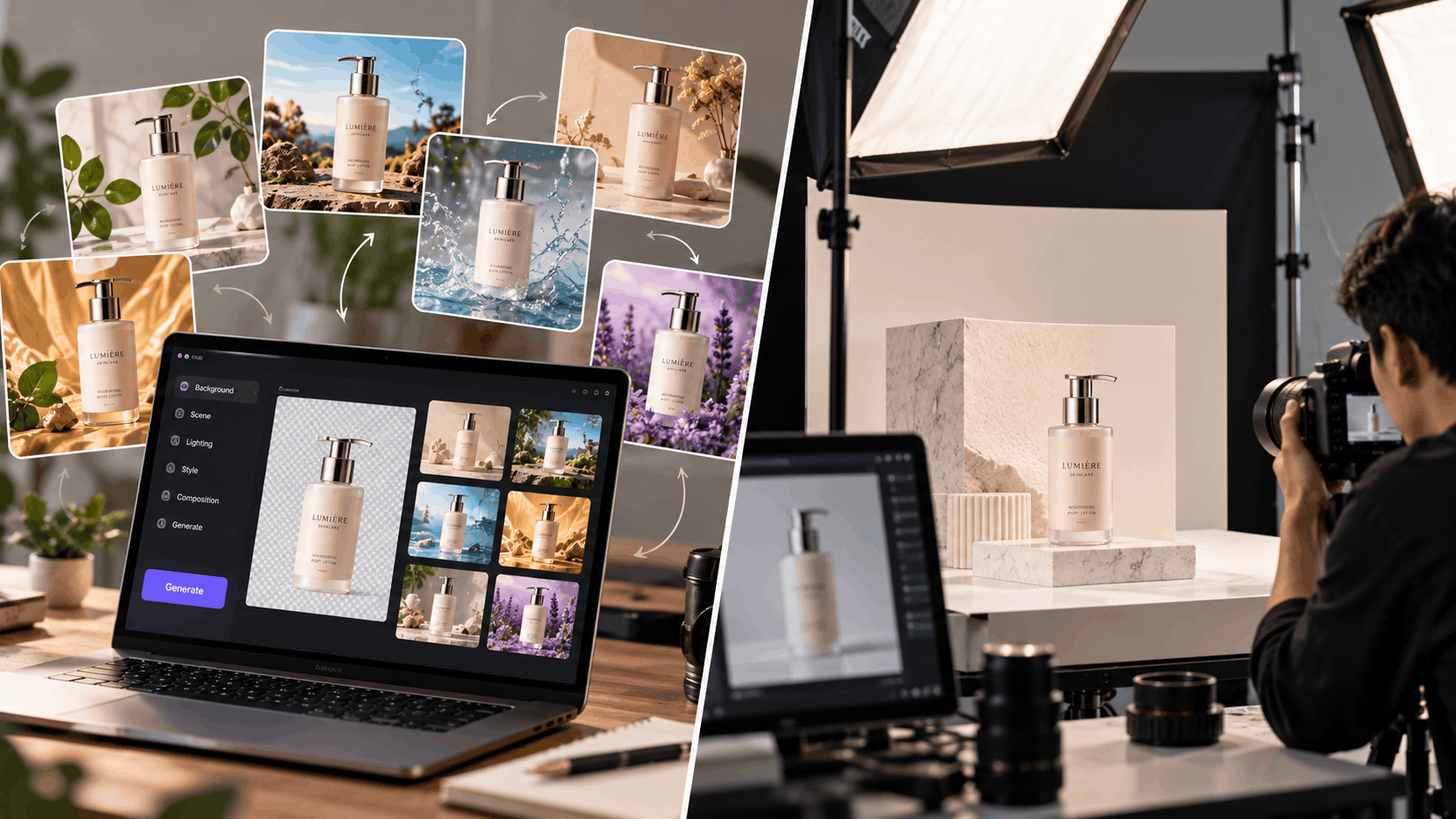
Can AI Product Photography and Studio Photography Work Together?
Absolutely. In many cases, combining them can be much more practical than treating them as competing approaches.
Studio photography can provide accurate, high-quality source assets. AI can then help turn those assets into additional advertising concepts, environments, and variations.
Photograph the Product Once, Then Use AI to Create Variations
Brands can start by capturing clean, accurate photographs of the physical product from useful angles.
Those images can become reference assets for AI product photography. The marketing team can then explore different backgrounds, settings, seasonal themes, and campaign concepts without repeatedly photographing the same item.
This gives the original shoot a much longer creative life.
Use Studio Photography for Hero Assets and AI for Performance Ads
Another approach is to divide creative based on purpose.
Use traditional photography for the polished hero images that define the campaign or brand. Then use AI to create the higher volume of variations needed for paid social, retargeting, promotions, and testing.
The brand keeps the quality of its core photography while gaining the speed needed for everyday advertising.
How AI-Generated Product Images Support Creative Testing
Creative testing works better when marketers can test genuinely different ideas rather than tiny changes to the same ad.
AI makes it easier to compare product settings, backgrounds, compositions, visual styles, seasonal concepts, and audience-specific directions. A team could take one product and quickly create several distinct visual approaches, then let campaign performance show which ones deserve further investment.
Those results can also influence future studio shoots. If AI testing repeatedly shows that a certain environment or composition performs well, the brand may decide to build that concept into its next traditional production.
In that sense, AI can help brands learn before they spend heavily.
Read more: AI Advertising for Ecommerce: Best Practices
How to Create Effective AI-Generated Product Images for Advertising
Good AI imagery starts with good inputs. Use clear, accurate product references and give the AI specific instructions about the setting, composition, audience, lighting, mood, and intended advertising format.
Keep the product itself consistent across variations whenever possible. If you're testing backgrounds, don't also change the product angle, headline, composition, and visual style all at once. Cleaner tests make it easier to understand what actually influenced performance.
Most importantly, review every image before publishing. Check logos, packaging, colors, proportions, product features, text, reflections, shadows, hands, and any other details that could make the visual inaccurate or distracting.
AI can generate the options. The marketing team still decides which ones are ready to represent the product.
AI-Generated Product Images vs Studio Photos: Which Should You Choose?
The choice depends on what the image needs to accomplish.
Use AI-generated product images when the priority is speed, creative volume, testing, seasonal campaigns, or adapting existing assets to new concepts. Studio photography is often a better fit when exact product details, human interaction, or highly controlled creative direction are essential. For many brands, combining both is the most practical approach: create accurate source assets in the studio, then use AI to extend those assets into more advertising creative.
The Future of AI Product Photography in Advertising
AI product photography is making product imagery less dependent on repeated physical production. Brands can take existing assets and explore new environments, concepts, formats, and campaign ideas much faster than before.
Traditional photography still has an important role, especially when accuracy, human interaction, or detailed creative control matters. AI simply gives marketers another way to extend those assets and keep up with the volume of creative modern advertising requires.
Leapify helps brands create fresh advertising visuals and variations with AI without turning every new campaign idea into another photoshoot. Teams can explore new product scenes, develop more creative concepts, and keep testing without rebuilding the production process every time.
Ready to see how much further your existing product creative can go? Sign up for Leapify today and start creating.
Frequently Asked Questions
Can AI-Generated Product Images Be Used for Advertising?
Yes. AI-generated product images can be used for advertising when they accurately represent the product and comply with applicable advertising and platform requirements. Brands should review generated images carefully for incorrect product details, misleading visuals, altered packaging, or other inaccuracies before publishing them.
Are AI-Generated Product Images Cheaper Than Studio Photography?
AI-generated product images can reduce production costs when they allow brands to create new scenes and variations without organizing additional photoshoots. Actual costs depend on the AI tools, amount of human editing required, creative volume, and complexity of the product imagery.
Can AI Product Photography Replace Traditional Product Photography?
AI product photography can replace some traditional photography tasks, particularly for creative variations, backgrounds, concept testing, and performance advertising. Traditional photography remains useful when exact product accuracy, complex physical details, human interaction, or highly controlled art direction is important.
How Accurate Are AI-Generated Product Images?
The accuracy of AI-generated product images varies depending on the tool, source images, prompts, and complexity of the product. AI can alter logos, labels, colors, proportions, materials, or small product features, so every advertising image should be checked against the actual product before publication.
What Products Work Best With AI-Generated Advertising Images?
Products with clear shapes, strong reference photography, and relatively simple visual details can be easier to reproduce consistently with AI-generated advertising images. Products with intricate text, transparent materials, reflective surfaces, unusual geometry, or highly specific functional details may require additional editing or traditional photography.