
AI ad creation has become an important part of modern advertising because marketers need to produce more creative content without slowing down campaign execution. AI ad creation software helps teams generate copy, images, videos, UGC-style content, and multiple creative variations from a single workflow. Instead of spending days coordinating every production step, marketers can use AI advertising tools to move from concept to campaign-ready creative much faster.
This article explains how the technology works, its benefits, limitations, and the features marketers should evaluate before choosing a platform.
How Does AI Ad Creation Software Work?
AI ad creation software combines generative technology, marketing inputs, brand information, and creative workflows to produce advertising assets. Marketers provide a product, service, offer, audience, or campaign objective, and the software can turn those inputs into multiple forms of creative content.

Generating Ad Copy and Messaging
AI ad creation software can generate headlines, primary text, calls to action, product descriptions, and other advertising copy based on campaign goals. Marketers can quickly create several messaging angles, then select and refine the versions that best align with the brand and audience.
Creating AI-Generated Images and Graphics
AI ad creation software can produce AI-generated ads that include original visual concepts, product-focused graphics, promotional layouts, and social media creative. This allows marketers to explore more visual directions without commissioning every concept through a separate design process.
Producing Video and UGC-Style Ads
AI tools can help marketers create short-form videos, product demonstrations, promotional clips, and UGC-style advertisements from structured prompts and existing brand information. This makes video production more accessible for teams that need frequent creative updates but lack extensive internal production resources.
Automatically Creating Multiple Ad Variations
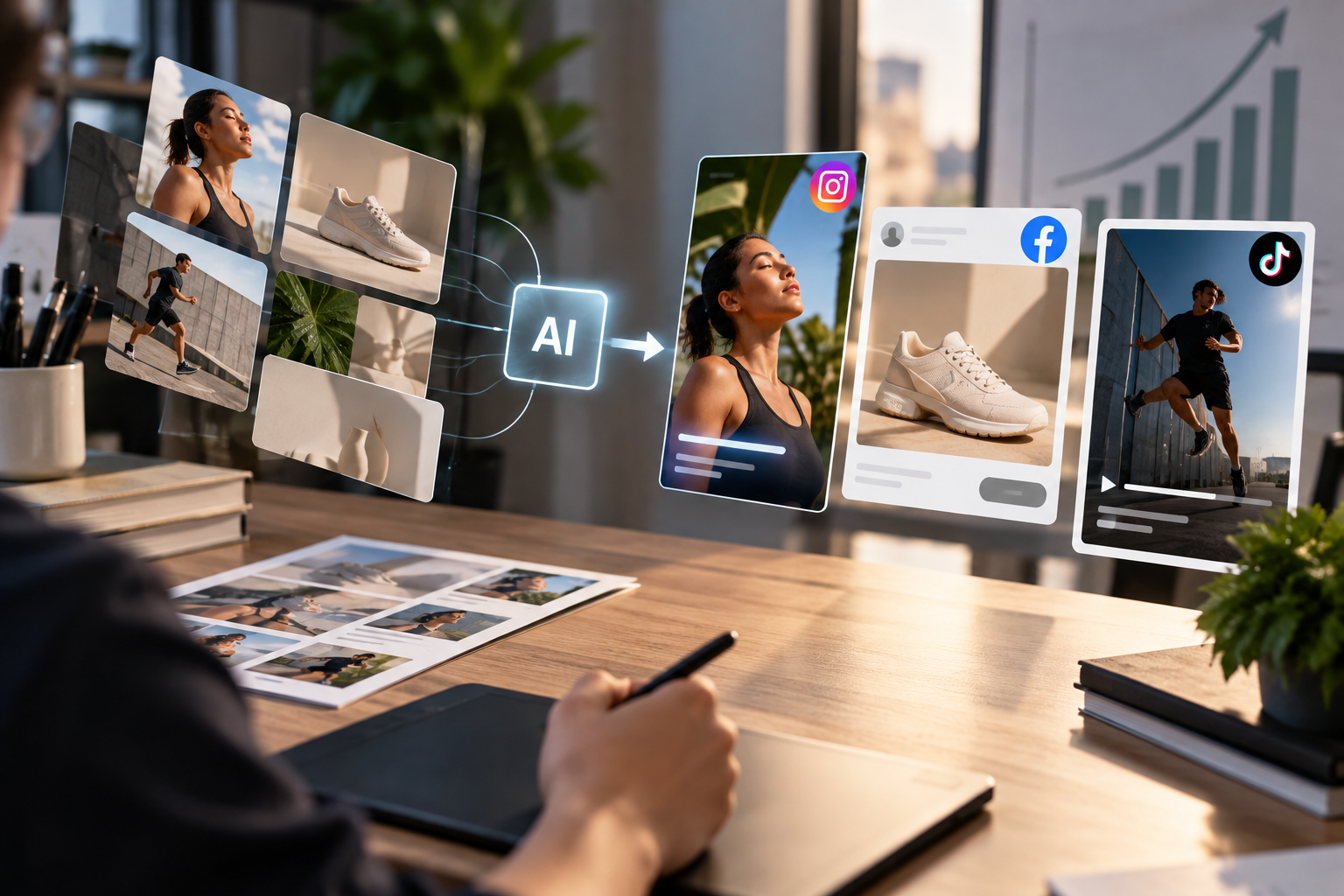
Automated ad creation allows marketers to turn one campaign concept into multiple combinations of headlines, visuals, offers, formats, and calls to action. More variations give advertising teams a larger creative pool for testing without requiring every version to be built manually.
Adapting Creatives for Different Platforms and Formats
AI ad creation software can resize and restructure creative assets for different placements, including social feeds, stories, display placements, and other digital advertising formats. This helps marketers maintain consistent messaging while adapting creative to the technical requirements of each channel.
Using Performance Data to Improve Creative Decisions
AI advertising workflows can use campaign performance information to identify patterns in creative engagement and conversion behavior. Marketers can then use those insights to inform new concepts, messaging angles, and variations instead of relying entirely on assumptions.
Why Modern Marketers Need AI Ad Creation Software
Modern marketers need AI ad creation software because advertising requires constant creative production, testing, optimization, and adaptation. The technology does not eliminate strategic marketing work, but it can reduce the time and resources required to execute that work.
1. AI Ad Creation Makes Creative Production Faster
AI ad creation can shorten the time between an idea and a usable advertising asset. A process that once required separate copywriting, design, video, and production stages can begin from a single marketing brief and produce several creative options quickly.
2. AI Ad Creation Helps Reduce Advertising Production Costs
AI ad creation can reduce production costs by minimizing repetitive manual work across copy, design, resizing, and creative variation. Lower production demands can allow marketing teams to allocate more of their budgets toward media buying, strategy, research, and campaign optimization.
3. AI Ad Creation Software Makes It Easier to Scale Campaigns
AI ad creation software makes scaling easier because marketers can produce larger volumes of creative without increasing production resources at the same rate. This is particularly useful for agencies, e-commerce brands, franchises, and service businesses that run multiple campaigns or target several audience segments.
4. AI Advertising Tools Help Combat Creative Fatigue
AI advertising tools help marketers refresh campaigns by generating new combinations of visuals, messages, hooks, and formats. Frequent creative updates can help prevent audiences from seeing the same advertisement so often that engagement declines.
5. AI Ad Creation Enables Faster Creative Testing
AI ad creation enables faster testing because marketers can develop multiple creative concepts before launching a campaign. Instead of debating which single advertisement deserves the budget, teams can test several controlled variations and use performance data to guide the next round.
6. AI-Powered Advertising Supports Greater Personalization
AI-powered advertising can help marketers tailor creative messaging to different audiences, products, offers, and campaign objectives. Personalized variations can make advertisements more relevant while giving teams greater flexibility in how they communicate with specific customer segments.
7. Creative Automation Frees Marketers From Repetitive Tasks
Creative automation reduces repetitive tasks such as resizing assets, generating alternative headlines, and adapting content for different placements. Marketers can spend more time on positioning, audience research, campaign strategy, and interpreting performance instead of manually rebuilding similar assets.
AI Ad Creation vs. Traditional Ad Creation
AI ad creation is generally faster and more scalable than traditional production, while traditional creative development can provide greater hands-on control over highly customized concepts. The right approach depends on the campaign, available resources, creative complexity, and required production volume.
AI should therefore function as a production advantage rather than a replacement for marketing judgment.
How AI Ad Generators Improve Performance Marketing
AI ad generators improve performance marketing by making creative testing faster, more systematic, and easier to scale. Marketers can use an AI ad generator to produce multiple hooks, messages, visuals, and formats, then compare results against defined campaign objectives.
Performance marketing depends heavily on learning from results. More usable creative variations can give teams more opportunities to identify the messaging and visual combinations that resonate with specific audiences.
What Types of Ads Can AI Ad Creation Software Produce?
AI ad creation software can produce many of the creative formats used across paid digital marketing campaigns. The most useful formats depend on the platform, audience, product, and campaign objective.
AI Image Ads
AI image ads can include promotional graphics, product-focused advertisements, lifestyle concepts, and branded social media visuals. These assets are useful for campaigns that need frequent visual testing without requiring a new photoshoot for every concept.
AI Video Ads
AI video ads can support short promotional videos, product demonstrations, explainers, and social-first advertising content. Marketers can create multiple video concepts to test different hooks, pacing, messages, and calls to action.
AI UGC Ads
AI UGC ads replicate the conversational structure and presentation style commonly associated with user-generated content. They can help brands test testimonial-style messaging, product demonstrations, and creator-inspired formats at greater volume.
AI Social Media Ads
AI social media ads can be adapted for platforms that rely on fast-moving visual content and concise messaging. Creative variations can be developed around different hooks, offers, audiences, and content formats.
AI Display and E-Commerce Ads
AI tools can create display banners, promotional graphics, product advertisements, and e-commerce creative designed around specific products or offers. Multiple dimensions and messaging variations can be produced more efficiently for campaigns with large creative requirements.
Who Can Benefit Most From AI Ad Creation?
AI ad creation is especially useful for teams that need frequent creative production and rapid campaign testing. It can benefit:
- Small businesses with limited creative resources
- Marketing agencies managing multiple client campaigns
- E-commerce brands promoting large product catalogs
- Startups testing different customer acquisition messages
- Performance marketers running continuous creative experiments
- Franchise businesses adapting campaigns across locations
- In-house marketing teams handling multiple channels
The greatest value typically comes from organizations where creative volume and speed directly affect campaign performance.
Key Features to Look for in AI Ad Creation Software
The best AI ad creation software should combine creative generation with brand controls, workflow management, testing, and performance insights. Marketers should evaluate the complete workflow rather than choosing a platform based solely on its ability to generate images or copy.
AI Image Generation
AI image generation should create useful advertising visuals while giving marketers enough control over the intended style, subject, composition, and campaign purpose. Strong tools should also make it easy to turn visual concepts into usable ad creative without requiring extensive design knowledge.
AI Video Generation
AI video generation should support short-form advertising formats, promotional concepts, and multiple creative variations. Look for tools that simplify production while still giving marketers control over messaging, visuals, pacing, and brand presentation.
AI Copy and Headline Generation
AI copy and headline generation should produce multiple messaging options aligned with the product, audience, offer, and campaign objective. The strongest workflows allow marketers to edit, compare, and refine generated copy rather than treating the first output as final.
Creative Templates and Brand Controls
Creative templates and brand controls help maintain consistency across advertisements, campaigns, and teams. Useful controls can include brand assets, messaging guidelines, visual preferences, approved content, and reusable layouts.
Automated Creative Variations
Automated creative variations allow marketers to generate different combinations of hooks, copy, imagery, offers, and formats. This capability is particularly valuable when a campaign requires dozens of assets for meaningful testing.
Multi-Platform Ad Formats
Multi-platform ad formats allow creative to be prepared for different advertising placements without having to rebuild every asset manually. The software should support common dimensions and formats relevant to the channels a marketing team uses.
Creative Testing Capabilities
Creative testing capabilities help marketers compare different advertising concepts and identify stronger performers. Testing features should make it easy to organize variations and connect creative decisions to measurable campaign outcomes.
Collaboration and Workflow Features
Collaboration and workflow features keep marketing teams aligned during creative development and approval. Shared libraries, comments, project organization, and centralized assets can reduce unnecessary back-and-forth between marketers, designers, and stakeholders.
Performance Insights and Analytics
Performance insights and analytics help marketers understand which creative approaches deserve further investment. Useful reporting should connect advertising results with creative variables such as messaging, format, visual treatment, and audience.
Integrations With Existing Marketing Tools
Integrations with existing marketing tools help teams incorporate AI creative into established workflows instead of creating another disconnected system. Connections with advertising platforms, analytics tools, content libraries, and marketing systems can make adoption more practical.
For teams looking for a centralized workflow, Leapify brings AI ad creation, images, videos, UGC-style creative, hooks, copy, brand knowledge, and creative assets into one platform. This can help service businesses move from a marketing idea to multiple advertising concepts without managing every creative task separately.
Challenges and Limitations of AI-Generated Ads
AI-generated ads still require human review because such content can contain inaccuracies, weak messaging, inconsistent branding, or unsuitable visual details. Marketers should review every asset for factual accuracy, brand compliance, copyright considerations, platform policies, and audience relevance before publication.
Common limitations include:
- Inconsistent outputs between creative variations
- Generic messaging without strong brand direction
- Incorrect product details
- Visual inaccuracies
- Limited understanding of nuanced brand positioning
- Need for human quality control
- Potential compliance concerns in regulated industries
AI works best when marketers provide clear inputs and maintain a strong approval process.
How to Use AI Ad Creation Without Losing the Human Element
AI ad creation works best when humans remain responsible for strategy, positioning, quality control, and final approval. Marketers should define the audience, offer, brand voice, campaign objective, and creative direction first, then use AI to accelerate production and expand the range of ideas.
A practical workflow can include:
- Define the campaign objective.
- Identify the target audience.
- Establish the core offer and message.
- Provide brand guidelines and approved assets.
- Generate multiple creative concepts.
- Review and refine the outputs.
- Launch controlled tests.
- Analyze performance.
- Create the next round based on results.
This approach combines automation with human judgment instead of treating generated content as a finished marketing strategy.
The Future of AI Ad Creation and Creative Automation
The future of AI ad creation will focus on connected creative workflows that move from strategy and concepts to production, testing, and optimization more efficiently. As AI marketing software becomes more integrated, marketers will increasingly use one workflow to manage copy, images, videos, variations, brand assets, and creative insights.
Creative automation is also likely to become more responsive to campaign data. Instead of producing static batches of advertisements, future systems will increasingly help teams identify underperforming creative and generate new variations based on observed results.
Why AI Ad Creation Is Becoming Essential for Modern Marketers
AI ad creation is becoming essential because creative volume, testing speed, and campaign complexity continue to increase. Marketers who can efficiently produce and evaluate more relevant creative can respond faster to audience behavior and campaign performance.
The technology also changes how teams allocate their time. Instead of spending most of their production hours creating repetitive assets, marketers can focus more heavily on customer research, strategic positioning, creative direction, and optimization.
AI is not a substitute for strong marketing fundamentals. It is a way to execute those fundamentals with greater speed and scale.
For businesses that want to simplify the creative process, Leapify provides tools that help teams create better ads in minutes, from initial concepts through images, videos, copy, UGC-style content, and organized creative assets. Sign up today!
Frequently Asked Questions
What is AI ad creation?
AI ad creation is the use of artificial intelligence to generate advertising content such as copy, images, videos, headlines, and creative variations. It helps marketers produce and test advertising assets faster while keeping humans responsible for strategy and final approval.
What is AI ad creation software?
AI ad creation software is a platform that uses artificial intelligence to help marketers develop advertising creative at scale. Depending on the platform, it can generate copy, images, videos, UGC-style advertisements, creative variations, and assets for multiple advertising formats.
Can AI create complete advertisements?
Yes, AI can create many of the components needed for a complete advertisement, including copy, visuals, video, headlines, and calls to action. Human review is still important for brand accuracy, factual claims, creative quality, compliance, and campaign strategy.
What are the benefits of using AI for ad creation?
The main benefits include faster production, lower repetitive production costs, greater creative volume, easier campaign scaling, and faster testing. AI can also help marketers produce variations for different audiences, platforms, messages, and campaign objectives.
Can AI ad creation improve advertising performance?
AI ad creation can improve advertising performance by helping marketers produce more creative variations and test them faster against measurable campaign goals. Results still depend on factors such as audience targeting, offer quality, messaging, media buying, creative strategy, and human optimization.




.png)